
The student, ready.
To listen, to reason, to decide
A platform for health professions schools that brings together clinical practice with realistic patients, structured assessment, usage data, and supported implementation.
Higher education institutions
Students
Active clinical cases
Years in the market
Countries
Clinical education has evolved. Hands-on practice can keep up.
Health professions education has trained generations of excellent clinicians through lectures and occasional hands-on practice. What changed is the context: larger class sizes, competency-based curricula, and a national exam that is more clinical. Program leaders gain more control when they can also see usage, progress, and gaps, before the assessment, not after it.

Practice left to student initiative
Students practice when they can, not when the curriculum needs them to.
Limited visibility
Program leaders decide without usage and progress data by cohort.
Scaling by hand
Standardizing clinical skills assessment consumes faculty time and operational capacity.
Your class has 40 students or 200. Does every one of them practice the same way?
How much each student practiced, by which criteria, and with what progress usually depends on beds, rooms, actors, examiners, and schedules. With Paciente360, the whole class works through the same cases, with the same criteria and a record for each student, without depending on any of that.
One clinical case, a different gain for every seat.
Those who learn can make mistakes safely. Those who teach gain time. Those who coordinate and lead see evidence before the assessment, not after it.
Make mistakes here, not with the patient.
Practices history taking, hypotheses, and management in a safe environment and gets immediate feedback on where to improve.
Practice that scales.
The same quality of practice across every cohort, campus, and term, without depending on beds, rooms, or examiners.
Ready-made cases, more time to teach.
Runs, discusses, and assesses each student's reasoning, without building cases from scratch.
The whole class on the same scale.
Same case, same criteria, and reports by cohort and term, so you can act before the assessment, not after it.
Evidence instead of anecdote.
Clinical practice data by student, cohort, and term to support the DCN's programmatic assessment and MEC (Ministry of Education) processes.
From history taking to management, with human standardized patients.
These are not illustrations: they are real screens from the platform. The student runs the encounter, examines, listens for heart and lung sounds, and decides.
A case library you can't fake.
More than 350 cases with human standardized patients, each one scripted, filmed, and clinically validated. An asset like this takes years to build, and it is what separates training decision-making from answering multiple-choice questions.
Active clinical cases
Medical Studies
Nursing
Preclinical years
ENAMED/DCN Track, expanding

The encounter happens by voice.
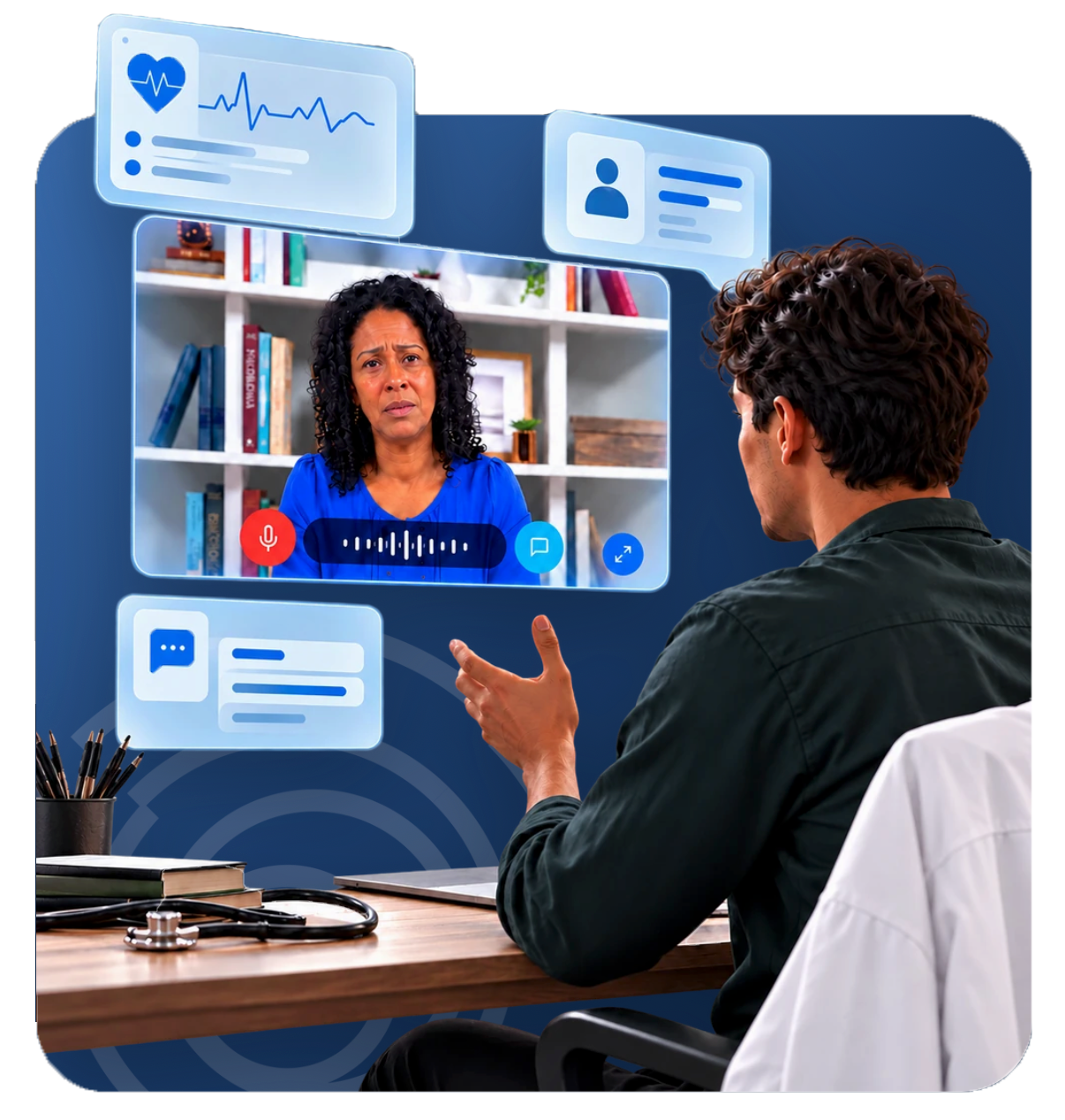
Beyond recorded cases, students now run the encounter by talking with a virtual patient. No multiple choice: they ask in their own words, the patient responds, and the feedback points to the next step, based on the DCN (national curriculum guidelines).
Faculty create the case.
Students run the encounter by talking.
The assessment follows the DCN.
From diagnostic
to progress.
Access without usage creates no value. Implementation is supported end to end, so the purchase becomes adoption and adoption becomes evidence.
1
Diagnostic
We map your institution's landscape.
2
Rollout plan
We structure the practice routine.
3
Accounts and cohorts
We set up users and access.
4
Training
We prepare faculty and students.
5
Follow-through
We track real engagement.
6
Next steps
We guide continuous improvement.
Integrated solutions that turn access into usage, and usage into evidence.
OSCE
Assessment
Structured stations, scoring rubrics, and performance tracking by competency.
ENAMED/DCN Track
Regulatory
Turn regulatory pressure into a guided, trackable practice routine.
Clinical Simulation
Practice
Interactive cases with realistic patients and voice conversation with Live 360 to train clinical decisions before in-person practice.
Implementation & Support
Adoption
More than access: diagnostic, training, support, and engagement reporting.
From theory to clinical decision-making.
Meet Paciente 360 through the people who built it. In a few minutes: why a group of physicians decided to build a clinical practice infrastructure for health professions schools, and what it changes for those who teach, assess, and learn.
Our partners
Alongside institutions and professionals who share our values, we develop solutions that connect knowledge, innovation, and practice.




































News on health professions education, straight to your inbox.
Once a month: what we're learning about clinical practice, assessment, the DCN (national curriculum guidelines), and ENAMED. No spam.
Let's find the right path for your institution.
Schedule a 360 Diagnostic and receive a rollout recommendation built around your scenario: audiences, student volume, usage maturity, and an adoption plan.